Fermentation for all!!
I’ve always been something of a do-it-yourself kind of gal. The idea of being able to make something with my own hands that I would typically buy premade in the store has always appealed to me. In high school, I was fascinated with trying to make my own clothes. More often than not, I reverted to my mom’s trusty fabric shears, cutting the hems off of long skirts to make them minis and turning oversized T-shirts into crop tops (a habit I’m still loyal to today). One of my friends said that anytime we would see something that we liked while shopping, I would confidently say, “I could make that.” Could I actually? No, not with any sort of skill or finesse, but the spirit of creation was alive in me, albeit naively!
My generation, as millennial ’90s kids, inherited a life of pre-made foods: Betty Crocker cake mix boxes, packets of Jell-O pudding mix powder, Skippy, Pop-Tarts, Hamburger Helper, Eggo waffles, Toll House cookie dough, etc., etc. As a kid, these foods were what they were to me. I didn’t know you could make peanut butter with peanuts and a blender or jam with strawberries, sugar, and a pot. By the time I came around in 1995, the notion of making anything from scratch, at least in my small world, was a complete unknown.
When I was old enough to operate an Easy-Bake Oven, a world of possibilities opened up for me. I have to give my mom credit here, because her crusty, dusty 1980s copy of the Betty Crocker Cookbook had a permanent place on our counter. I was a waffle enthusiast. I must have made Betty’s from-scratch waffle recipe at least 200 times before I turned 16. And the best part about it? Betty’s homemade “maple syrup” recipe that accompanied it. At the time, to me, maple syrup was what came out of the Log Cabin bottle. I didn’t know that it actually came from trees, but Betty showed me a way to boil sugar with molasses and maple flavoring that yielded an amber elixir more delicious than anything I’d ever globbed out of Mrs. Butterworth’s plastic bottle body. I instinctively knew there was something important in those recipes that wasn’t coming off of the shelves at Safeway.
During the COVID lockdown days, I bought my first kefir grains off Amazon and started making my own kefir. I loved challenging my own inner notion that milk sitting in a jar at room temperature for two days was going to spoil. I was enthralled watching it actively alchemize into a completely new, delicious, and luxurious substance by the powerful and hungry engine of a few tablespoons of living bacteria. This was even more magical than what I witnessed coming out of my Easy-Bake Oven, but the sentiment holds true: food, time, and temperature is alchemy.
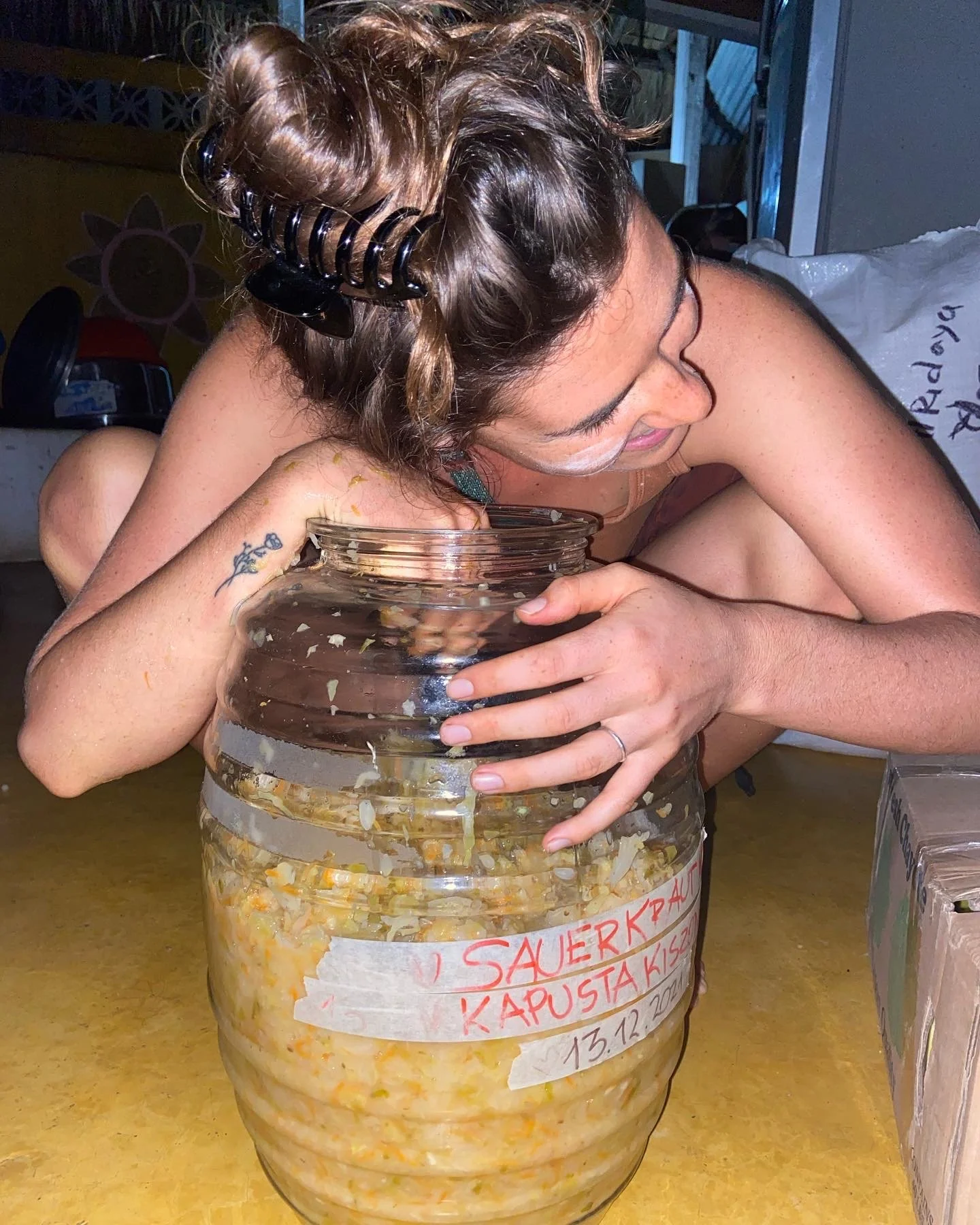
I really started getting into fermentation a few years ago while living in Mexico with my Polish bestie, Basia. The first thing I ever saw her ferment was sauerkraut. What else is a Slavic girl to do in 85% humidity but shred up a whole head of cabbage to leave brewing on the communal kitchen counter for weeks? I was interested. At the time, I don’t think I had ever even tasted sauerkraut before, let alone one that had been actively bubbling under a kitchen cloth next to the fridge with a handwritten sign that said “do not touch, por favor <3.”
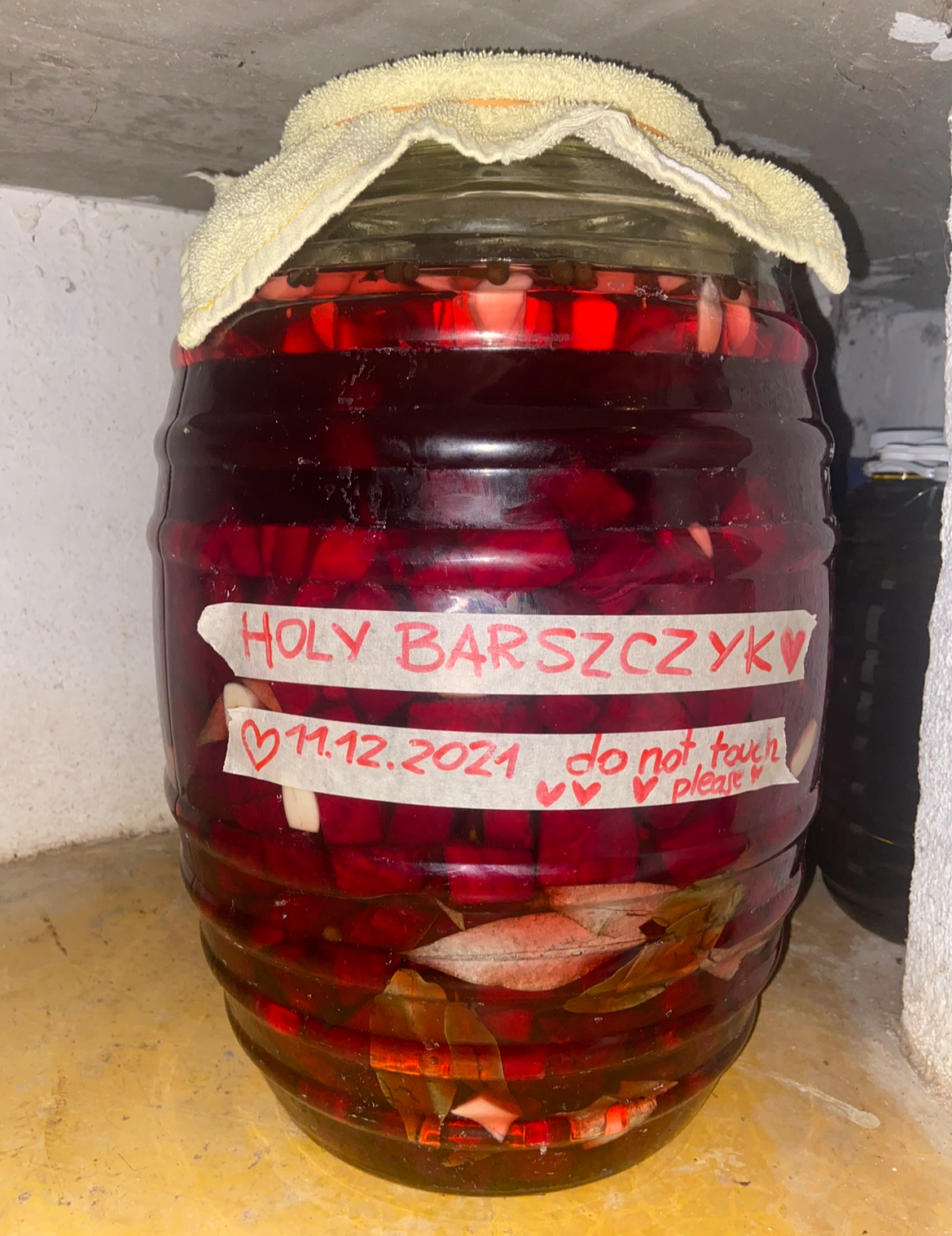
For Basia’s family living in Eastern Europe, fermentation was, and continues to be, a staple in their everyday lives. In the summer, their garden produces tiny cucumbers, which her mother brines into pickles (the best pickles you’ve ever tasted, by the way) to be stored in their underground cellar throughout the winter. Beets become kvass, which becomes borscht for their Christmas dinner. They have multiple bottles of medicinal, homemade botanical vodkas silently aging in a dark closet in the house. Fermenting and preserving is as common as cooking in her family and seamlessly weaves its way into the landscape of their everyday diet. So much of the Eastern European diet is composed of fermented foods as a simple and practical way to make their provisions last all year long. And Basia’s grandparents, who grew up in war-torn Poland during WWII, were keen not to waste anything. As a Western woman, this was quite simply a foreign concept to me, and also something that made so much intuitive and practical sense. And I am nothing if not practical! Entonces, Basia started teaching me how to ferment like a Slavic girl.
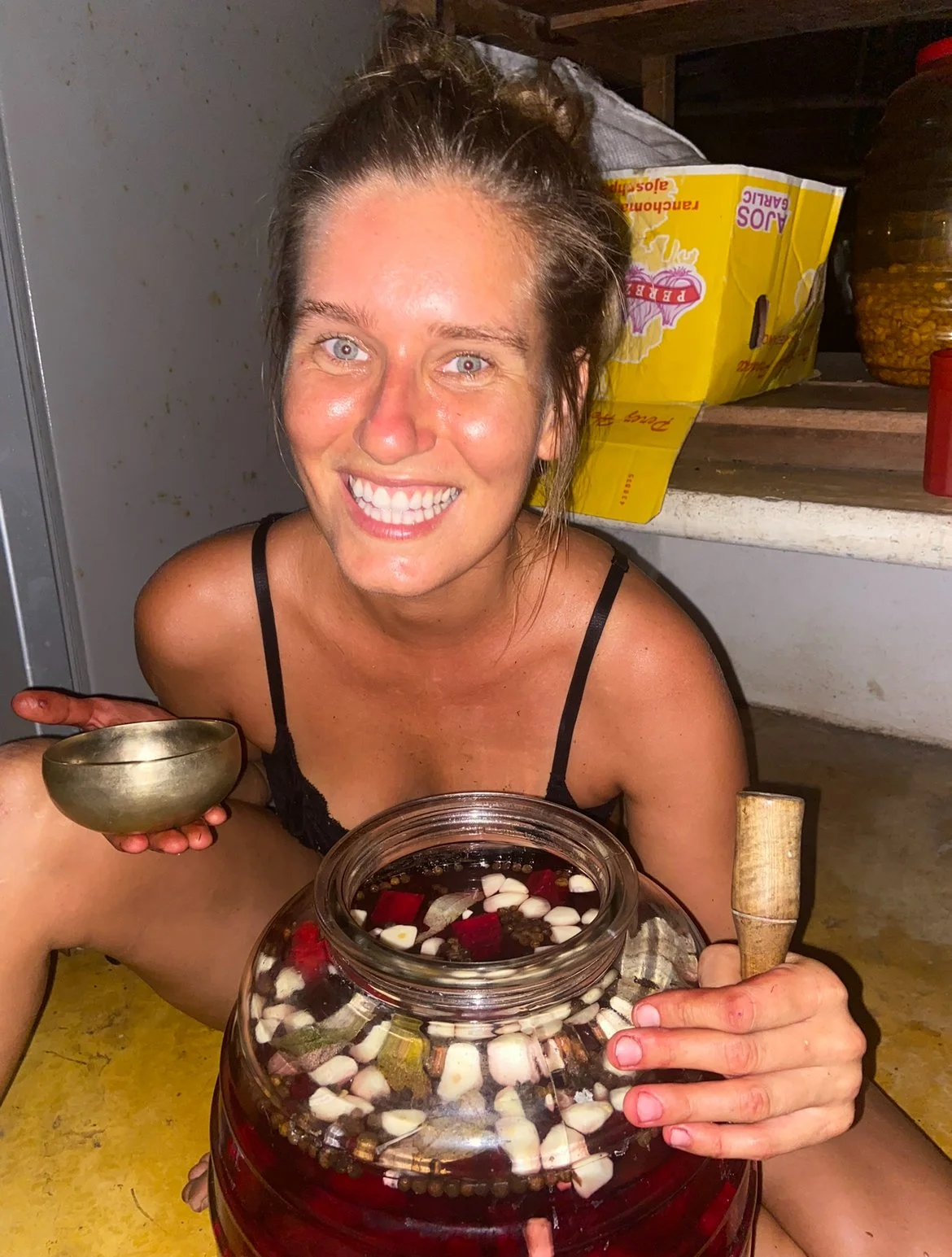
my fermentation guru herself blessing the holy kvass
We made coconut yogurt with the water and flesh of coconuts we had cracked open ourselves, and powder probiotics from a pill that some Irish boy was taking for his IBS. We made tepache, a traditional Mexican kombucha/beer of sorts composed of pineapple skins, cinnamon, chiles, and raw Mexican cane sugar called piloncillo. We fermented mung beans in water and ate them sprouted and raw. We made apple cider vinegar from the apple cores and skins we used for apple pie. We used black tea bags to make SCOBYs for our homemade kombucha. The way we were fermenting was raw, spontaneous, experimental and intuitive. We leaned heavily on Basia’s ancestral knowledge and instinctual guidance and we really just didn’t overthink it. Fermenting with Basia took DIY cooking to a whole new stratosphere for me. I was introduced to a brand new territory of cuisine that used the naturally occurring live bacteria in our world to transform the taste, texture, and composition of ordinary foods into something I had never experienced before. I am amazed (and always continue to be) by the unique range of flavors that fermenting foods produces—the way I can manipulate time and temperature into creating different balances of sweetness, acidity, effervescence, funk, and tang.
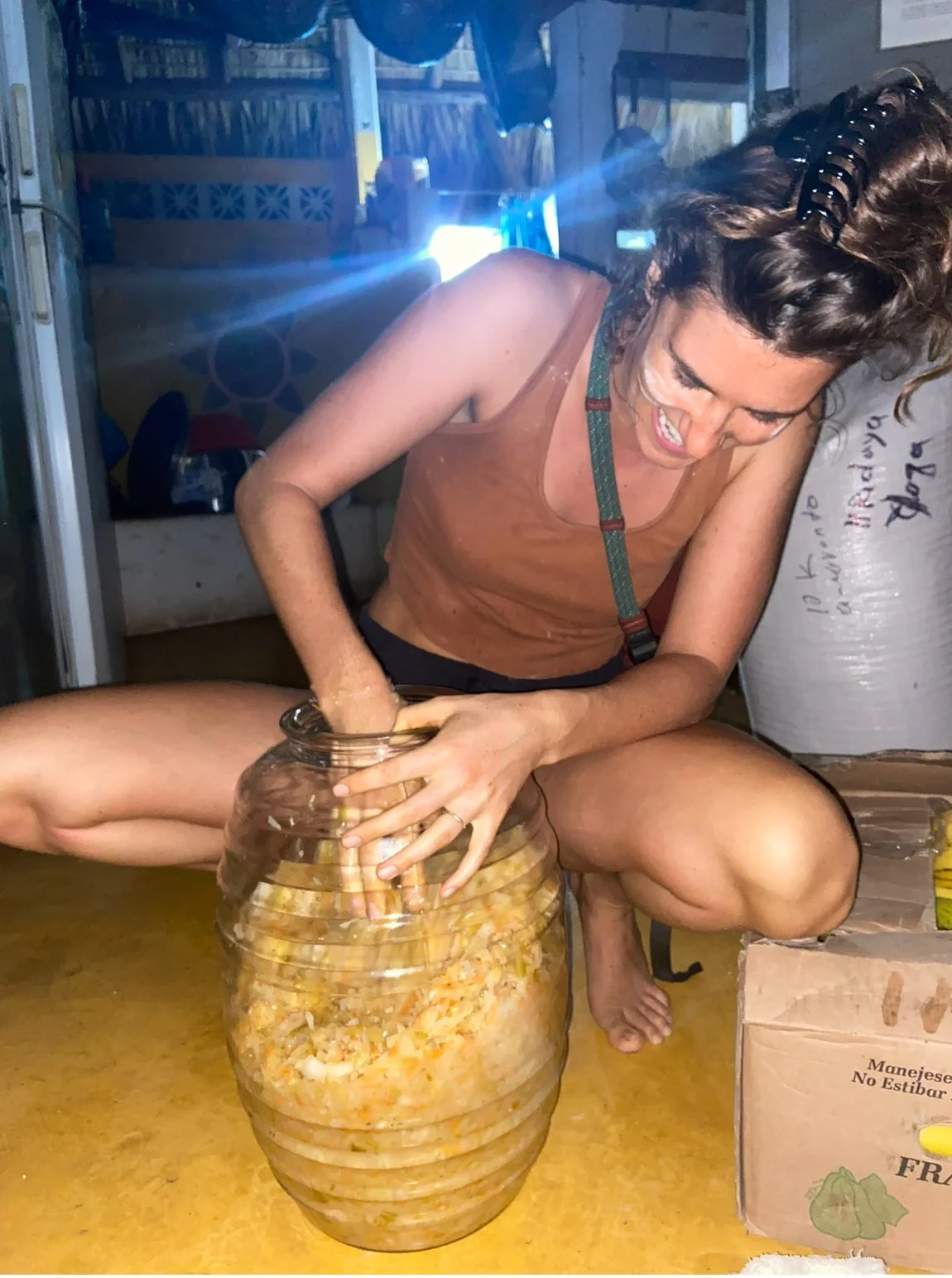
I felt like I was stepping back in time—or, more accurately, that I was breaking through the progressive timeline of the modern convenience food conglomerate that I had been raised with and become accustomed to. It became clear to me that the virtue of convenience is so overly glorified in our American food culture (and culture at large) that we have completely lost our grasp on the merit of preserving our own food. Fermenting felt like recovering a lost ancient language, like reawakening a dormant part of my ancestral DNA through the probiotic codes in Lactobacillus bacteria. Fermenting felt like the ultimate “fuck you” protest to the overly taxed, homogenized, and processed foods that have robbed us of the unbridled magic of witnessing the primordial, alchemical wizardry of nature.
There has been a major adoption of fermented foods into the mainstream health and wellness empires over the last several years. While you used to have to go to your local co-op or farmer’s market to buy handmade sauerkraut from some hippie in a hemp skirt, you can now stroll over to your local Whole Foods and peruse the kimchi- and kefir-lined shelves. Green-labeled as “probiotic” and “microbiome-friendly,” the new era of health food adorns a stylish label and is marked up to oblivion. This has created a new split in the accessibility of ferments to the average American consumer, because who wants to spend $12 on a jar of kefir?
I’d be remiss not to acknowledge that fermentation has made a major comeback in the mainstream culinary world in the last few decades (Noma, etc.), and this is pretty cool. It has allowed fermentation to be viewed as a legitimate, intentional, and refined cooking technique that is worth dedicating an entire menu to. However, I also feel it has inflated an extremely simple and ancient culinary practice into something completely out of reach and even pretentious to the average consumer. This has elevated the rudimentary practice of fermenting into an upper echelon of society and further out of the hands of the ordinary person. Fine dining restaurants are investing thousands into creating fermentation labs, tinkering with ratios, and using medical-grade technologies to make foods that nonnas have been making in clay jars in their cellars for centuries.
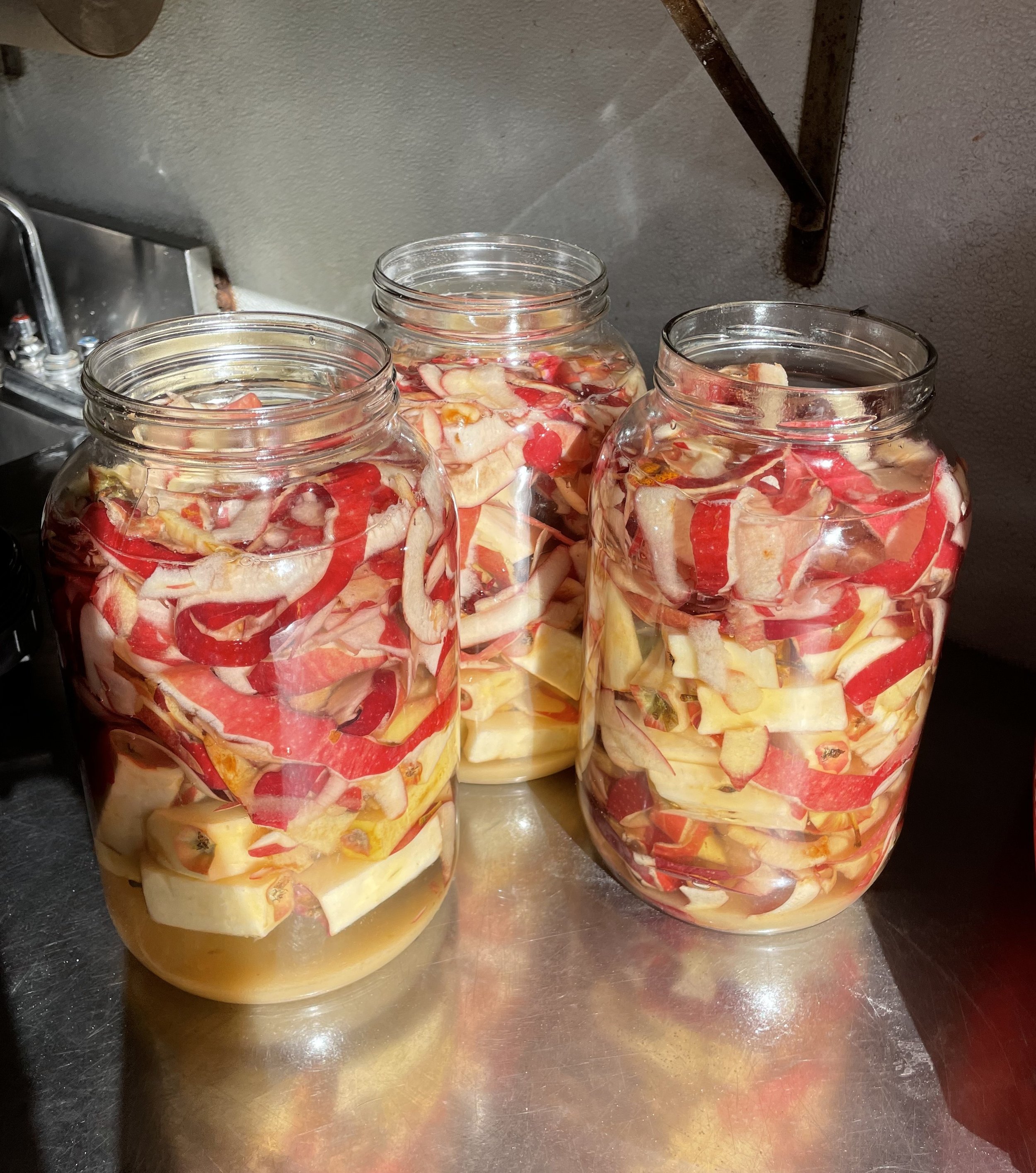
ACV made from local Big Sur apples
Fermentation, in its nature, is simple, affordable, and anyone can do it. Maybe it’s just my simple mind, but I don’t want to have to feel like I’m opening a laboratory to be able to add salt, water, and raw foods to a jar. A few years ago, I bought The Noma Guide to Fermentation, a beautiful and painfully detailed, scientific manifesto on all things fermenting. While I am sure this book is an excellent and exhaustive resource on all things fermentation, I’ve hardly used it at all because I found it to be way too academic and heady. Maybe that appeals to some people who naturally take a more left-brained approach to life, but for me, I prefer to learn more through my senses and less through my mind.
I think the real beauty and empowerment that comes from making our own simple foods from scratch, fermented or otherwise, is found in easefully weaving these practices into the daily rituals of our lives. I hope to see a world someday soon where the average person has a bottle of something bubbling away in their pantry and knows that it really can be just that simple—where we can lean more heavily on the generational wisdom of our ancestors who have been practicing simple food preservation for centuries. Fermenting is a slow process. It takes time, patience, and looking ahead to the future. If we can learn to lean even just a little bit less on the convenience of immediacy in our food, we will gain the reward that nature provides us for just letting her do her thing.
So, as a humble effort to demystify fermentation, I’d like to offer a simple and straightforward recipe that you could start today and be enjoying by Friday. Tepache is one of the first ferments I ever made and its tropical, fizzy and almost yeasty flavor delighted me SO much that I still continue to make it regularly whenever I peel a pineapple. The beautiful thing about this recipe is that it’s made from a pineapple byproduct, making it a truly zero-waste recipe. Start fermenting and turn your trash into treasure today!
INGREDIENTS
Skins and core of at least one pineapple
1 cup brown sugar, or pilloncillo if you can access it
2 cinnamon sticks
1-2 small chiles, any kind you like. You could use Thai chiles, chile de árbol, even serrano, jalapeño or habanero (if you want it spicy, if not skip the chiles)
You’ll also need a one gallon glass jar, some kind of kitchen cloth, a rubber band, a wooden spoon and a strainer or cheese cloth.
METHOD
Begin to prepare your vessel by disinfecting it. Boil enough water to fill your jar, pour the boiling water into the jar and let stand for 10 minutes. Pour it out and your jar is ready to go.
Peel your pineapple, reserving the top, skins and the core. Use the flesh for something else, or eat it!
Rinse your pineapple skins to remove any weird stuff, then stuff them all into the jar with the cinnamon stick, chiles (if using) and sugar.
Cover the whole thing with fresh filtered water.
Give it all a good stir with a wooden spoon and cover the top with a kitchen cloth or cheesecloth, securing it with a rubber band. The tepache needs to be exposed to air to allow the fermentation process to happen, but you also want to protect it from any curious critters.
Put the jar somewhere in your kitchen or pantry, the warmer the climate, the faster it will ferment.
Check the jar and make sure to stir it at least once a day. Preferably twice daily! The pineapple skins will naturally float to the top, so make sure to press them down and stir them everyday because when bacteria is exposed to air too long it causes mold. As long as the skins are routinely submerged in the water your tepache will be perfectly fine. Just don’t put it in your pantry for 4 days and not touch it once because it will become a furry jungle in there.
Continue to add ½ a cup of sugar to the jar for the first 2 days to keep the fermentation process going. The bacteria on the pineapple skin eats the sugar and their gaseous byproduct is what makes the bubbles and ferments the liquid. These guys need food to do their work!
Taste it!! I like to taste my ferments at least once a day so I can track how the flavor is developing and know when I want to stop. By the second or third day you should see bubbles rising to the surface of the jar. As the days go on, the flavor will change from sweet, to more tangy and alcohol-y. After about 4-5 days the tepache is essentially an alcoholic beverage with an alcohol content similar to beer, so beware. If you continue to let it ferment, in a few months it will become vinegar. I like to find a happy place somewhere between the taste of kombucha and beer. For me this typically happens around 3-4 days but the results will vary drastically according to the temperature of your environment. So continue to taste it and taste it until you’ve reached a flavor you are happy with.
When you’re ready, strain the tepache in a fine mesh strainer or through a cheesecloth. Keep it in the fridge. Enjoy and revel in the alchemical magic you just made in your own kitchen!!!!